The Outreach 100 Fastest‑Growing Churches in America list (2025) comprises 100 congregations whose attendance rose sharply in the past year. Collectively they served roughly 596k worshipers with over 77k new attendees and an average numeric growth of about 777 people per church. Growth percentages averaged around 20.6%, and the correlation analysis shows that larger churches tend to post bigger numeric increases but smaller proportional gains. These churches span a variety of traditions, technology stacks and regions, and their data provides a window into where and how vibrant congregations are expanding.
Disclaimer
This analysis draws on the Outreach 100 survey and our own research into church‑management software and giving platforms. Not every congregation in the United States participates in Outreach’s data collection, and some churches may be changing systems even as you read this. The information presented here should be seen as a snapshot of trends rather than a definitive or permanent record.
Defining Church Size Terms
In this report we sometimes describe congregations as small, medium, large or mega. All of the churches in the Outreach 100 list draw more than 1,000 people each weekend and would therefore be considered large by most general standards. To provide nuance within this group, we define size categories relative to the distribution of the list:
Size Category By | Average Weekly Attendance | # of Churches |
Small | 1,000–3,000 | 38 |
Medium | 3,000–7,000 | 39 |
Large | 7,000–15,000 | 15 |
Mega | Over 15,000 | 8 |
These ranges are approximate and serve only to help readers interpret scale differences within this particular dataset.
Where Church Growth Is Happening
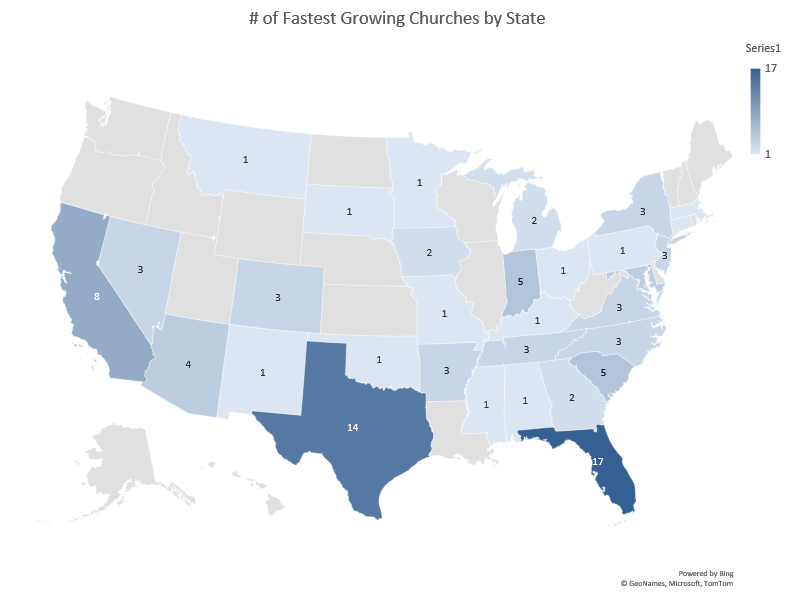
Location matters. Florida and Texas dominate the list, hosting 17 and 14 of the fastest‑growing churches respectively. California follows with eight, while Indiana and South Carolina host five each. When grouping by broader U.S. regions, the South accounts for nearly 60% of the churches and two‑thirds of the total growth, reflecting both population trends and a dense evangelical landscape. The West claims 20 churches but records the highest average numeric growth (~1,014), largely because it includes some of the largest congregations. Midwestern churches average around 840 new attendees, whereas Northeastern churches tend to be smaller and average 366 new attendees.
Denominational Success
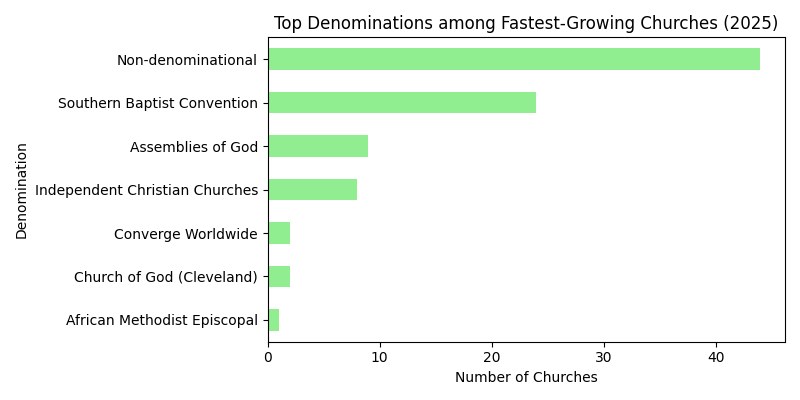
The fastest‑growing list skews non‑denominational, with 44 churches not formally aligned with a traditional denomination. These congregations average 22.5% growth and illustrate how independent churches often adopt agile models and contemporary worship styles. Among denominational groups:
- Southern Baptist Convention (SBC) congregations are the largest denominational block, with 24 churches and about 16.5% average growth.
- Assemblies of God churches (nine) post average growth above 22%, reflecting the movement’s emphasis on evangelism and church planting.
- Independent Christian Churches number eight and average 19% growth.
- Other groups on the list include Full Gospel Baptist, African Methodist Episcopal, Vineyard Churches, Christian & Missionary Alliance, Evangelical Presbyterian, and Fellowship of Evangelical Churches.
Top Church Management Systems & Giving Platforms
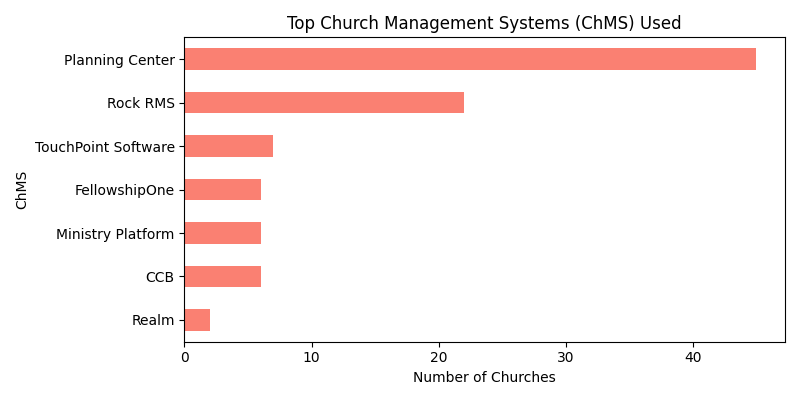
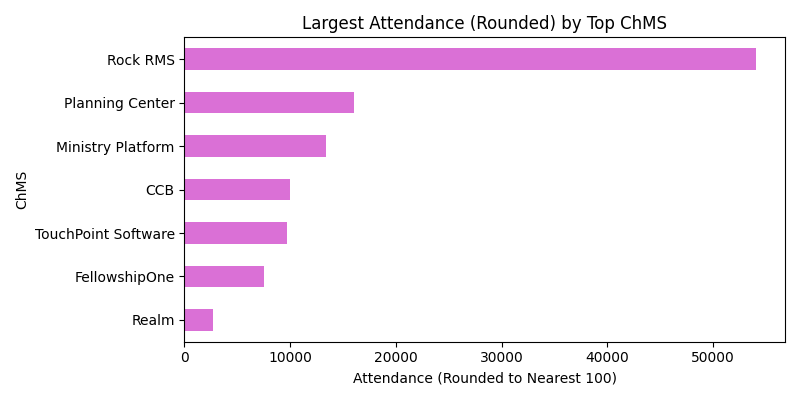
Technology choices show clear patterns. Planning Center is the dominant church‑management system (ChMS), serving 45 of the 100 churches. It supports churches across the size spectrum and is also the most common giving platform pairing. Rock RMS follows with 22 churches and tends to serve the largest congregations—the maximum attendance among Rock RMS users exceeds 54k. TouchPoint Software supports seven churches, with a top attendance around 9.7k, while Community Church Builder (CCB), FellowshipOne and Ministry Platform each serve six churches.
To understand how ChMS adoption relates to scale, it helps to look at the largest church each system serves. The chart below rounds attendance to the nearest hundred, illustrating the upper range each platform supports. Rock RMS’s high ceiling reflects its appeal among megachurches, while Planning Center serves some large churches they remain prevalent among mid‑sized congregations on this list.
*Keep in mind that these numbers are just relfective of the Top 100 Fastest Growing Churches List. Stay tuned for a comprehensive breakdown of Outreach 100’s Largest Churches List.
Common ChMS–Giving Platform Pairings
Pairing a ChMS with an integrated giving platform streamlines data flow and donor engagement. The most frequent combinations include:
- Planning Center + Planning Center Giving – 20 churches
- Rock RMS + Pushpay – 15 churches
- Planning Center + Pushpay – 11 churches
- Community Church Builder (CCB) + Pushpay – 5 churches
- FellowshipOne + Pushpay and TouchPoint Software + MyWell – 4 churches each
These pairings suggest that churches value seamless integration over mixing unrelated tools. Planning Center’s in‑house giving solution is popular among small and mid‑sized congregations, while Rock RMS users often integrate with Pushpay for its robust giving features. When selecting software, churches should prioritize platforms that synchronize contributions, attendance and discipleship engagement.
Fastest Growing Churches Awards
Every congregation on the 2025 list is a testimony to faithful ministry, yet a few standouts merit special recognition. These light‑hearted awards celebrate extraordinary milestones and remind us that growth comes in many forms:
- Highest Percentage Growth: Elevate Life Church in Wallingford, CT, recorded the largest proportional increase in attendance, demonstrating how a clear vision and strong community engagement can lead to remarkable momentum.
- Most Numerical Growth: CCV (Christ’s Church of the Valley) in Peoria, AZ, welcomed the greatest number of new worshipers. With its thriving ministries and regional influence, CCV continues to expand its reach.
- Smallest Attendance on the List: Oak Park Church in Mobile, AL, is the smallest church among the fastest‑growing. Its inclusion proves that size is relative—small congregations can achieve significant impact when they lean into discipleship and community outreach.
- Most Remote Church: Journey Church in Bozeman, MT, sits the farthest from any other church on the list. Its growth highlights how vibrant ministry can flourish even in locations far from population centers.
- Legacy Builder Award: Cross Church in Springdale, AR, is celebrated for its long‑range investment in multiplication and leadership. The church plants new congregations across the region and beyond, and through its “Decade of Love” plan (supported by its own seminary and Christian school) it’s equipping the next generation of church planters and ministry leaders.
Additional Insights for Database & Discipleship Strategies
- Larger churches grow numerically but face diminishing percentage growth. A strong positive correlation (~0.85) exists between attendance and numeric growth, yet a modest negative correlation (~−0.21) between attendance and percentage growth. Larger congregations gain more people in absolute terms but smaller churches tend to grow faster proportionally. This suggests that megachurches should focus on retention and engagement, while mid‑sized churches may benefit from outreach and assimilation efforts.
- Non‑denominational flexibility yields results. Non-denominational/Independent churches not only dominate the list numerically but also exhibit higher growth percentages. Many emphasize contemporary worship, small‑group discipleship and digital engagement, which may resonate with newcomers.
- Denominational stability still matters. Traditional bodies like the Southern Baptist Convention and Assemblies of God supply numerous fast‑growing congregations. While there are very few Presbyterian, Methodist, and Lutheran churches represented on this list.
- Technology is a growth enabler. The prevalence of all-in-one ChMS and giving platforms highlights the importance of robust data management for discipleship. Systems like Planning Center and Rock RMS consolidate attendance tracking, volunteer scheduling, small‑group management and online giving. When these tools feed into a single database, pastors can identify engagement gaps, develop targeted discipleship pathways and steward resources more effectively.
- Invest in volunteer and leadership development. Many growing churches emphasize training for leaders and volunteers, which is easier when processes are centralized. Software like TouchPoint features such as role‑based permissions, onboarding workflows and mobile apps can enhance leadership pipelines.
Fastest Growing Churches Recap
The 2025 Outreach 100 Fastest‑Growing Churches list underscores the diversity and dynamism of American Christianity. Growth is concentrated in the South and West, though healthy congregations can be found nationwide. While non‑denominational churches lead in numbers and proportional growth, established denominations like the Southern Baptists and Assemblies of God continue to produce thriving congregations. The widespread adoption of cloud‑based church management and giving platforms suggests that technology plays a critical role in managing growth and facilitating discipleship. For ministry leaders, these insights highlight the need to invest in scalable systems, cultivate strong leadership pipelines, and tailor outreach strategies to their context.