
If you’ve ever led your church through a major software change, you already know it’s not just a technical project. It’s an emotional one. People don’t simply adopt a new tool; they carry their habits, preferences, fears, and expectations into it. And when those expectations don’t match reality, frustration rises.
Frustration, at its core, is the emotional response to unmet expectations.
When churches decide to change their Church Management System (ChMS), emotions often swing from excitement to confusion to doubt, but if you stick with it—to relief. That pattern is normal. It doesn’t mean something is wrong. It means you’re working through change.
If your church is about to begin this journey, or if you’re somewhere in the messy middle, here’s encouragement and practical wisdom from someone who has walked through this with many churches over the years.
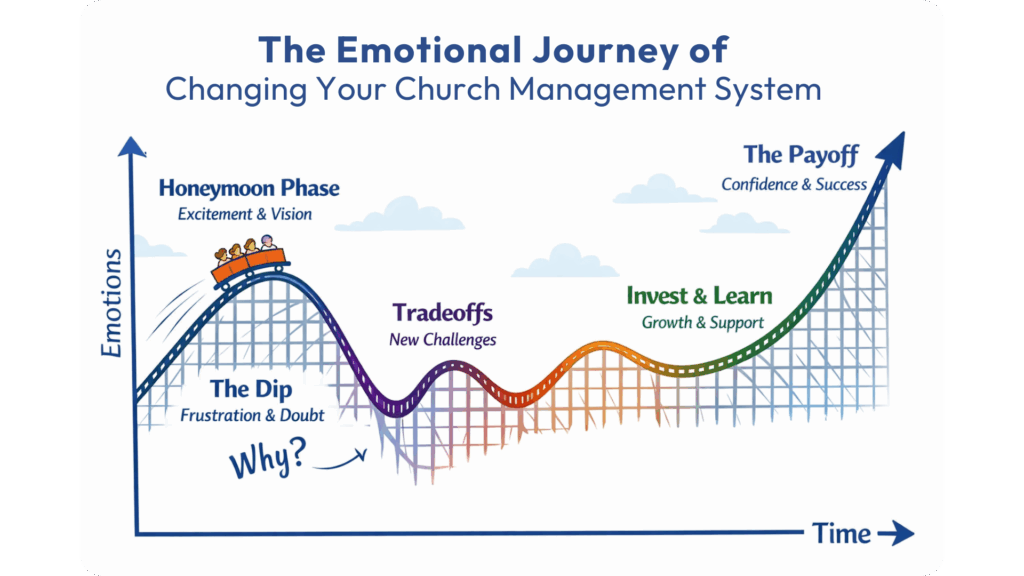
The Honeymoon Phase: Excitement and Vision
Every ChMS transition begins with clarity and hope. Your church didn’t make this decision casually. You had real reasons. Maybe you needed stronger reporting. Maybe your ministry teams were working in too many places at once. Maybe your discipleship data wasn’t giving you valuable insights.
Whatever the reason, you saw a better future. You saw what ministry could look like on the other side.
That why matters more than any one feature or function. It’s the anchor you’ll need to return to again and again.
Because once implementation begins, something else sets in.
The Dip: When Reality Meets Expectations
This is the moment most churches (and their new ChMS) don’t talk about publicly, but every staff member feels it.
You’re learning new workflows while still doing your weekly responsibilities.
You’re running your old system while trying to train in the new one.
And you’re discovering that the process you’ve become accustomed to over the years doesn’t translate perfectly into the new environment.
This is when emotions flare:
- “Why doesn’t this feel intuitive yet?”
- “Why can’t it work the way our old system did?”
- “Why does learning something new take more energy than I expected?”
Remember: frustration shows up when expectations don’t match the experience.
That’s why the most important step early in the journey is setting clear and reasonable expectations—for yourself, for your team, and for your leaders.
A ChMS switch takes time. It takes patience. It takes grace.
It’s not a sign of failure. It’s a sign of growth.
Staying Rooted In The “Why”

When bumps in the road appear, go back to the reason you began this journey.
You switched because the old system could no longer support the ministry you’re called to lead.
You switched because you wanted healthier data, better engagement tools, or mobile-first capabilities to reach the next generation.
You switched because you have a vision for where your church is going, not where it has been.
Short-term discomfort for long-term ministry health is always worth it.
Sometimes, in the middle of transition, the “why” gets blurry. You’re tired. You’re answering the same questions over and over. You’re trying to help your team make sense of changes that feel unnecessary or inconvenient.
This is the moment when you gently remind them:
The process isn’t the goal. The transformation is.
The Tradeoffs: New Strengths, New Challenges
Every system (old or new) has tradeoffs. You gain new capabilities, and you’ll probably lose some familiar shortcuts. You discover features that delight you and others that require new patterns or permissions.
This doesn’t mean the new system is deficient. It means it’s different.
Sometimes different feels like loss before it ever feels like gain.
Staff may grieve the muscle memory they had in the old system. Leaders may feel overwhelmed by new nomenclature or navigation. That’s okay. Let people name those feelings. Let them say it out loud:
“This part is harder than I expected.”
“This takes me longer than it used to.”
“I don’t understand why this works this way.”
Those aren’t complaints. They’re invitations to support your team, co-create solutions together, design more efficient processes or re-align expectations. Listen to them, make them feel seen and heard. And when necessary, redirect them back to the why behind the change.
When your people feel supported instead of dismissed, they stay engaged.
Communication And Culture: Your Bridge Through The Messy Middle
If there’s one thing I’ve learned watching churches navigate big transitions, it’s this: communication alone isn’t enough. You also need culture. The teams that thrive through a ChMS switch don’t just talk more. They pull together, create shared ownership, and build a learning environment people actually want to be part of.
Here are some practices I’ve seen churches use that make all the difference.

Build A Cross-Ministry Team To Finish The Race Together
The strongest implementations aren’t carried by one hero. They’re carried by a team.
The churches who handle change the best pull together a group of leaders from across ministry areas—children’s, students, adults, missions, operations, worship, and more. Each person is responsible for representing their area, but they’re also responsible for something else: becoming the go-to expert for one specific part of the new system.
Not everything.
Not the whole system.
Just one meaningful slice.
One person becomes the groups expert.
Another becomes the check-in expert.
Someone else takes on volunteer scheduling, giving, or workflows.
This shared expertise does two powerful things:
- It lightens the lift so no one person carries the weight of every question.
- It creates ownership and momentum because each person has a lane where they genuinely contribute.
When your team wins together, they also learn together.
Keep The Honeymoon Energy Going
It’s easy to start strong when excitement is high. The challenge is keeping that energy alive once the real work begins. The healthiest churches don’t treat training as a chore. They treat it as a celebration of growth.
That means thinking creatively:
- Host fun training parties instead of mandatory classroom sessions.
- Bring the team together for food, games, and hands-on practice.
- Celebrate milestones, even small ones.
RockPointe Church in Flower Mound, TX did an exceptional job with this. They understood that people learn better when their guard is down and their curiosity is up.
Use Bite-Sized Learning To Build Confidence
Broadmoor Baptist in Madison, MS also did something simple, yet effective to help with change management. They sent a simple “handy tip” every week — just one small, digestible idea staff could apply immediately. That rhythm did more than teach the system. It reduced overwhelm, built confidence, and helped people feel like they were growing little by little.
Change rarely sticks in big, dramatic moments. It sticks in repeated, bite-sized ones.
Make Exploration A Game, Not A Burden
Another creative approach Broadmoor used was a digital scavenger hunt. Staff had to hunt through the new system to find certain pieces of information or complete certain tasks. It wasn’t a test. It was an invitation to play.
And it worked.
People clicked around more.
They discovered things organically.
They grew more familiar with the layout and features.
Learning became something they wanted to do, not something they had to endure.
“Stump Your Database Expert”
One of my favorite ideas they used was a friendly challenge called “Stump Your Database Expert.” Staff were encouraged to ask hard, high-value questions to the resident database guru. This did three things:
- It encouraged deeper use of the new system.
- It showed staff that they could ask anything without embarrassment.
- It helped the experts stretch their understanding and problem-solving skills.
Everyone learned together, and everyone laughed together. That builds culture.
What This All Adds Up To
Strong communication during a ChMS transition isn’t about flooding people with information. It’s about creating an environment where people aren’t afraid of learning, where ownership is shared, and where curiosity is welcome.
When a church cultivates that kind of culture, the messy middle feels less like a burden and more like a journey that everyone is taking together.
The Parable of Switching Houses

Changing your ChMS is a lot like moving from one house to another.
When you live in a rental long enough, you get used to the quirks. You know which cabinet doesn’t close right. You know exactly where the good sunlight hits. You overlook things that once bothered you because they’ve become “normal.”
When you buy your first home (or decide to move from a starter house to a forever house) it’s exciting, but we all know that it’s also disruptive. You pack everything up. You uncover stuff you forgot you owned. You spend money on things you didn’t expect. You hire movers. You clean out closets. You sign paperwork. You fix things you didn’t know you’d need to fix.
It’s emotional. It’s exhausting. It feels like a lot.
But you endure the hassle because you know what waits for you on the other side.
You’re stepping into a home that fits your next season, instead of settling for your previous one.
A ChMS switch works the same way.
You’re investing extra time, effort, and money temporarily so your church can experience long-term stability, clarity, and ministry growth.
The short-term mess is part of the process of getting to a much better long-term home.
Investing In Help That Moves You Forward
If you’ve ever moved before—or if it has been a long time—you know there are moments when hiring movers is worth every dollar. The same is true in a ChMS transition. Churches that choose to invest, whether in people, training, or time, move through the change with more clarity and far less frustration. A new system isn’t something you stumble into. It’s something you learn with intention.
That investment can look different depending on your needs. Sometimes it’s leaning into the training and consulting your new ChMS provides. Other times it’s bringing in a third party to help your staff navigate the emotional and practical shifts that come with healthy change. You’re not paying for shortcuts—you’re paying for experience, perspective, and guidance that helps you avoid pitfalls you may not see coming.
And even if dollars are tight, you can still invest. Give your team the time and space to learn. Immerse yourself in documentation. Connect with nearby churches using the same platform. Seek out online communities or user groups where others share ideas and solutions. Isolation always makes the process harder.
You will get stuck at some point in the journey. That’s normal. What matters is whether your team has support when it happens.
Investing—financially or through intentional learning—shortens the dip, builds confidence, and helps your church step into the long-term health you envisioned when you made the switch.
The Payoff: When The New System Becomes Muscle Memory
There comes a moment when your staff stops comparing the new system to the old one.
They stop saying, “Where is this feature?” and start saying, “I know exactly where that is.”
They stop asking for help on every task and start teaching others how to do it.
That’s the turning point.
The new system starts to feel… normal.
Then it starts to feel natural.
Then eventually, it starts to feel indispensable.
That’s when you know you’ve made it home.
Final Encouragement
If you’re feeling the emotional swings of a ChMS transition, you’re not doing it wrong. You’re doing it right.
You’re investing in the future of your church’s ministry.
You’re making decisions that will serve people better, clarify your data, and strengthen your discipleship pathways.
Keep the “why” in front of you.
Set honest expectations.
Communicate more than you think you need to.
And remind your team that the short-term disruption is leading them to a healthier, more sustainable future.
You’re not just changing software.
You’re building a stronger foundation for the ministry God has entrusted to you.
About the Author

Ross Miller is the President of TouchPoint Software, where he leads the organization’s strategy, innovation, and long-term direction. With more than 25 years of experience in faith-based organizations (8 years at TouchPoint) Ross brings a blend of operational expertise, ministry insight, and a deep commitment to helping churches thrive.
Outside of work, Ross is a lifelong adventurer who loves surfing, snow skiing, climbing mountains, traveling, and playing music. He’s a seventh-generation Texan and lives in Dallas with his wife. Together they have three kids and have invested more than twenty years serving in the marriage ministry at Watermark Community Church.